
If you didn’t already know this, our brains learn faster and retain longer when we can connect new learning to things we already know. Endless lists of vocabulary words in English or foreign language class can feel overwhelming, but there are better ways to study.
FASTEST Method (to get started):
Try scanning the vocabulary list your teacher gave you and see how many you can learn just by looking at the list (hint: not many). This is a quick first pass, not a long-term strategy.
Next Step: Column Paper (Active Practice)
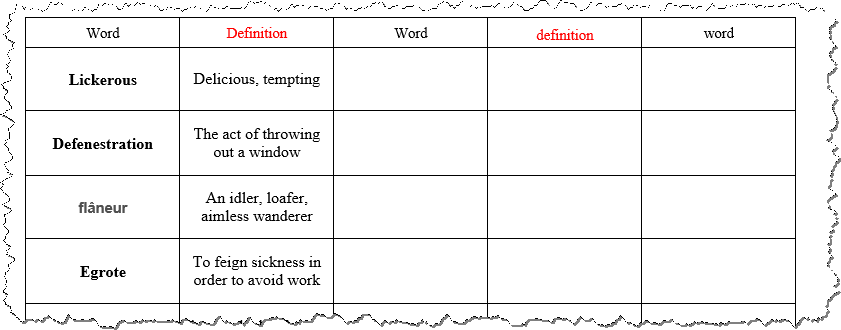
Column paper works like a deck of flashcards, but without the mess. Instead of writing a word once and flipping a card, you write it multiple times in columns, going back and forth between the word and its definition (or English and the target language).
You can even fold the paper to quiz yourself. It’s simple, active, and much more effective than passively reviewing flashcards.
Most Effective (for the tricky words): The LINC Method
When a word just won’t stick, this is where the LINC method shines.
LINC stands for:
List the word
Identify a reminding word
Note a linking story
Create a picture
This method works because it combines sound, meaning, imagery, and creativity. You’re not just memorizing, you’re building connections.
Example:
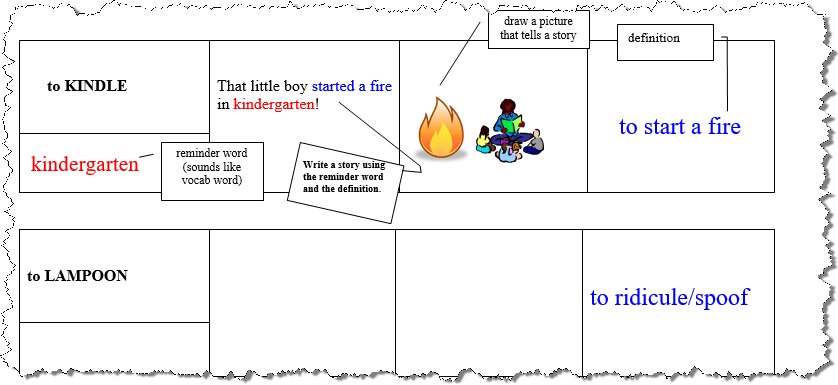
Let’s learn the word KINDLE, which means to light or set on fire.
- List the word: Kindle
- Identify a reminding word: Kindergarten
- Note a linking story: The little boy started a fire in kindergarten.
- Create a picture: (Imagine or draw it)
It’s a little unusual, and that’s the point. The more vivid or memorable the image, the easier it is to recall later.
If you have a list of 50 words to memorize, you might learn 10 just by skimming, another 30–40 through column paper, and then use LINC for the final few that won’t stick. It takes a little more time, but those are the words you’ll still remember long after the test.
Learning that actually lasts: Memorization doesn’t have to mean repetition without meaning. When students engage with words in multiple ways, saying them, writing them, visualizing them, and connecting them to something familiar, retention improves dramatically.
With the right support and the right learning environment, many students discover that school can begin to feel manageable again.
At Pacific Learning Academy, we help middle and high school students catch up, move ahead, and rediscover the joy of learning.
 Ready to explore options for your student and learn more about Accredited Middle & High School classes or academic support (tutoring)?
Let’s talk! Schedule a free consultation with one of our Academic Coordinators
Pacific Learning Academy is a one-on-one school based in Sammamish, Washington, offering single courses, dual enrollment, and graduation pathways for students studying curriculum at the middle and high school level. Pacific Learning Academy is Washington State Approved and a nationally accredited private school (Cognia). High School coursework is approved by the National Collegiate Athletic Association (NCAA) for student athletes and we are also a member of the Washington Federation of Independent Schools. Besides academic credit, the Academy offers tutoring support in all subjects from 6th to 12th grade either virtually or in person (in your Sammamish home, our Sammamish school office, or in local libraries across the Eastside). See more at www.PacificLearningAcademy.com.